Published: 11 Feb 2026
Now is the perfect time to explore a career in geospatial surveying. Surveyors are in high demand, the industry is inclusive and the opportunities are truly global. It’s a profession that lets you see the real-world impact of your work – from local communities to international projects – while offering a refreshing mix of outdoor work and data analysis back in the office. No two days are the same.
Working towards excellence
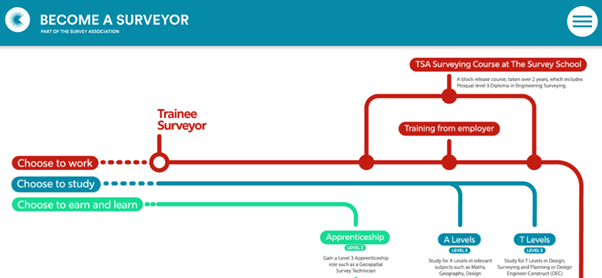
As part of our ongoing education initiative and the launch of the new Become a Surveyor website, we’ve looked at how to map out a career in surveying in a simple, informative way. Our route map sets out the various paths available to budding surveyors. There are three distinct routes to a successful career as a geospatial surveyor. You can choose to work, to study or to ‘earn and learn’.
If you choose to work, you’ll become a trainee surveyor. This will lead to hands-on instruction from your employer, and you can attend the TSA Surveying Course at The Survey School. You can then progress to becoming an assistant surveyor, which brings with it a new raft of responsibilities and the ProQual Diploma, an experience-based Level 3 qualification. This can then lead to becoming a fully-fledged Surveyor. The Survey School’s range of specialist courses can extend existing knowledge with an injection of short, subject-specific courses too. With increased experience comes seniority, and this can eventually lead to roles such as Principal Surveyor, Survey Project Manager or even becoming a business owner.
Studying towards success
Choosing to study is a more defined pathway and one many students in many sectors will be familiar with. This will involve taking A Levels in subjects relevant to surveying, such as maths, geography and design, or T Levels in technical areas such as design, surveying and planning, or Design Engineer Construct (DEC). This can then lead on to study for a Bachelor’s Degree in Geography, Civil Engineering or another related subject. It could also lead to studying for a Master’s Degree in Geospatial. By this point on the pathway, students will be fully-qualified surveyors, where they can then follow the same routes as the ‘choose to work’ path.
Learning while you’re earning
Another option is to become an apprentice. The Level 3 Geospatial Survey Technician was created specifically for this purpose. You can also combine work with study via a Degree Apprenticeship and later you can even undertake a Master’s Apprenticeship.
Our route map illustrates the flexible career routes available to candidates, which provides the freedom to build a career that fits your goals. Starting on one pathway doesn’t limit you. As you can see from the diagram, you can switch to another route at any time, to continue your career growth in a way that suits you.
To find out more about becoming a surveyor, visit our new website or get in touch for more information about careers in surveying.