Published: 19 Aug 2026
Taking the next step for sustainability
Across the geospatial sector, increasing numbers of businesses are measuring their carbon footprint, setting reduction targets and publishing their carbon reduction plans. This demonstrates that the profession understands the importance of sustainability. However, as client expectations continue to evolve, how can stakeholders be confident that the reported figures are accurate? The answer lies in independent third-party verification.
Moving beyond good intentions regarding environmental issues
Just stating that your business is committed to reducing its environmental impact is not enough. Clients want to understand how emissions are being measured, how reductions are being achieved and whether the claims being made will hold up under scrutiny. Independent verification helps provide that assurance.
Why verification matters when it comes to carbon reporting
Carbon accounting is complex, requiring organisations to gather data from multiple sources, apply recognised methodologies, use appropriate emission factors and make informed assumptions where direct data is unavailable.
Independent verification provides a level of external scrutiny that helps ensure carbon emissions have been calculated consistently, accurately and transparently. It provides confidence that the reported figures present a fair representation of an organisation’s environmental impact. It turns carbon reporting from a statement of intent into evidence-based information that clients and stakeholders can trust.
Building confidence with clients
Many TSA clients are under increasing pressure to understand and reduce emissions throughout their supply chains. As a result, they are placing greater emphasis on the environmental performance of their suppliers.
Verified carbon reporting gives clients confidence that the information they receive has been independently assessed rather than suppliers ‘marking their own homework’. In an environment where concerns about greenwashing continue to grow, that credibility can be a significant advantage.
Supporting supply chain carbon reduction
Many organisations struggle to manage their Scope 3 emissions which are generated throughout their wider supply chains. In many sectors, Scope 3 emissions account for the largest proportion of a company’s overall carbon footprint and can be the most difficult to measure and reduce.
When suppliers provide verified emissions data, clients can use that information in place of generic industry assumptions. This can improve the accuracy of their own reporting and provide a clearer picture of where meaningful reductions can be achieved.
As clients become more sophisticated in their carbon accounting, supplier-specific data is likely to become increasingly valuable. Businesses that can provide credible, independently verified emissions information may find themselves better positioned to support their clients’ sustainability objectives and become the preferred supplier.
Reducing carbon emissions can drive better business performance
The verification process may highlight opportunities to strengthen data collection, improve operational efficiency and identify carbon reduction measures that also reduce costs. So, the measures that reduce carbon emissions can also improve operational performance and profitability.
For geospatial surveying businesses, these opportunities may include:
- Improved fleet efficiency and fuel management.
- Reduced energy consumption.
- Better utilisation of equipment and resources.
- More informed procurement decisions.
- Stronger internal reporting systems.
Attracting and retaining talent
Sustainability is increasingly important to employees, particularly younger professionals entering the industry. Many people want to work for organisations that demonstrate genuine commitment rather than simply publishing aspirational statements. Independent verification shows employees that sustainability is being measured, monitored and managed with the same professionalism applied to other areas of the business. This can strengthen employee engagement, support recruitment efforts and contribute to a positive organisational culture.
Measuring carbon with the same rigour as measuring the built environment and natural world
Geospatial surveyors use calibrated equipment, recognised standards, quality assurance procedures and professional judgement to produce information that clients can trust. As professionals whose reputation is built on accurate measurement, surveyors should aspire to apply the same standards of rigour, transparency and accountability to their carbon reporting.
Sustainability is increasingly influencing procurement decisions, supply chain relationships, client expectations and corporate reputation. For TSA members, independently verified carbon reporting represents an opportunity to demonstrate leadership, build trust and strengthen competitiveness.
Verification can improve data quality, support business development, enhance client confidence, identify efficiencies and contribute to stronger long-term business resilience.
Most importantly, it reflects the values that have always defined the surveying profession: accuracy, transparency and trust.
Mike Hopkins MCInstCES – Storm Geomatics Limited, says,
“Having our carbon emissions reporting independently verified to ISO 14064 each year has been transformative. It has enabled us to provide lower Scope 3 emissions to our clients while giving us the data and confidence to reduce our own footprint.
“Five years on, the benefits are clear: greater profitability, more customers, increased business opportunities, and the ability to attract people who share our values. Verification has shown that doing the right thing for the planet can also be good for business.”
Next steps
The surveying profession has always been built on accuracy, transparency and trust. By measuring emissions, reducing them where possible and independently verifying the results, TSA members can demonstrate the same professional standards in their sustainability reporting as they do in the services they provide every day. The first step is simple: review your current carbon reporting and ask whether it is sufficiently robust, transparent and independently assured to inspire confidence among clients, employees and stakeholders. If the answer is no, now may be the time to act.
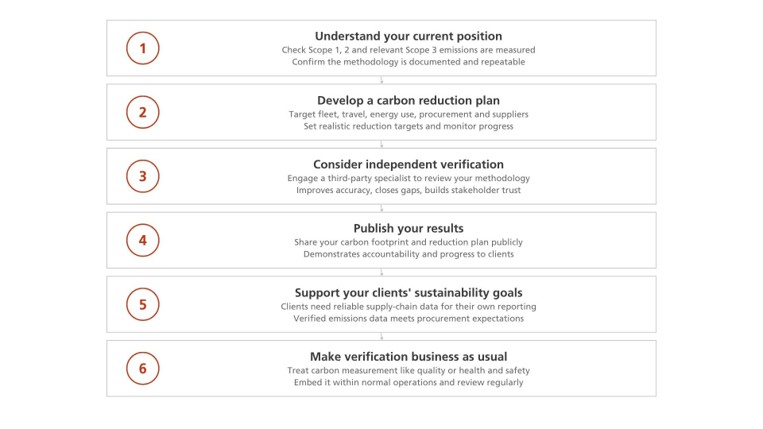
Find out more about making verification part of business as usual by contacting a carbon verification company such as Interface NRM.